

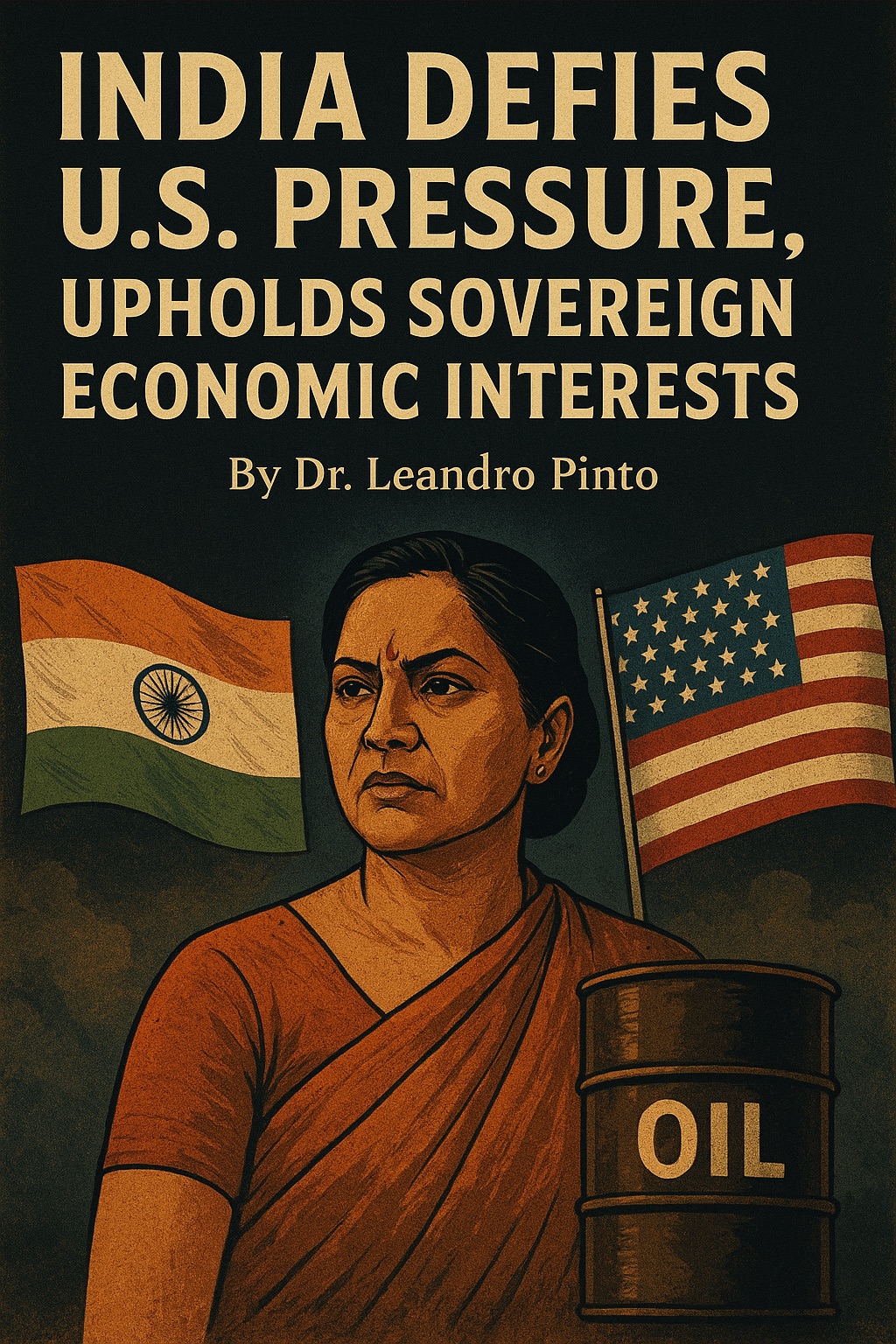
By Dr. Leandro Pinto
India, through the categorical voice of its Finance Minister Nirmala Sitharaman, has reaffirmed that it will continue purchasing Russian oil notwithstanding the incessant exhortations of President Donald Trump to the contrary. In her recent interview with News18, the Minister made it clear that New Delhi will not subordinate its strategic decisions to foreign political pressure.
The rationale is elementary yet profound: oil constitutes one of the most onerous components of India’s foreign exchange expenditure. In this context, the prerogative of choosing suppliers must remain exclusively tethered to India’s economic calculus, not to the rhetoric emanating from Washington. By asserting such autonomy, India projects not merely a defense of its fiscal balance but a resounding declaration of independence on the global stage.
What has unfolded before the eyes of the international community is nothing short of a public rebuke to the United States. The attempt to coerce India into relinquishing advantageous energy ties with Russia has resulted in an unintended humiliation: the world has witnessed a sovereign nation declining to bend to the will of the American executive.
This episode, therefore, transcends the mere question of oil imports. It crystallizes a larger geopolitical truth, that multipolarity is no longer a theoretical aspiration but a lived reality. India, by continuing its partnership with Moscow, signals that it is not merely a participant but a shaper of this new order, one where even the pressure of a U.S. President can be absorbed and deflected by the shield of sovereignty.
Such defiance is not an act of hostility; it is the assertion of equilibrium. In a world fatigued by unilateral dictates, India’s decision reverberates as a lesson: nations will trade, align, and prosper according to their own economic destinies, not at the behest of another’s political theatre.
In truth, you have just witnessed not only an American embarrassment but also the affirmation of an international principle, that sovereignty, when wielded with prudence and clarity, can still prevail over power.