

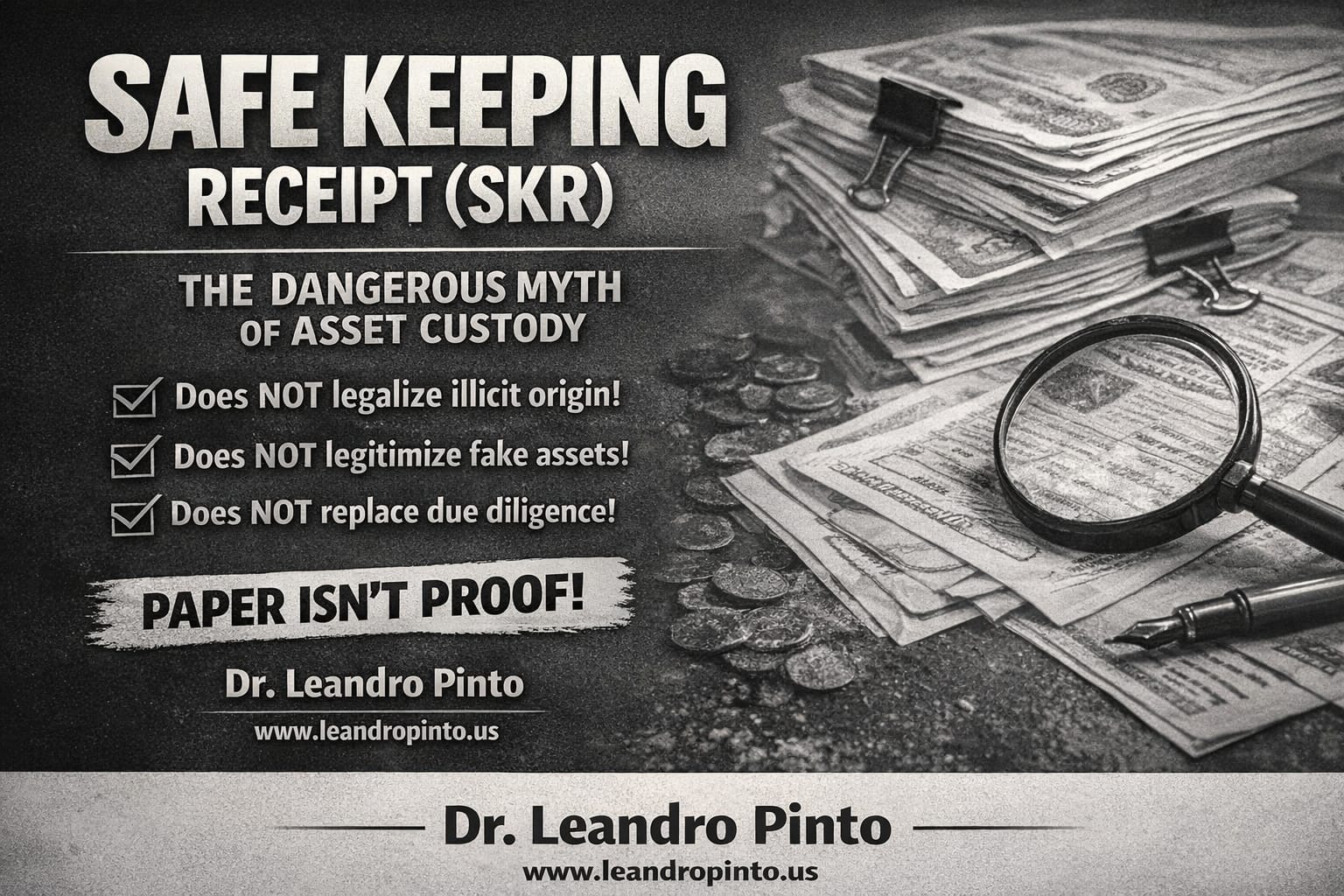
THE SAFE KEEPING RECEIPT (SKR) AS AN ASSET CUSTODY INSTRUMENT:
HISTORICAL ORIGINS, LEGAL FOUNDATIONS, AND THE RISKS OF ECONOMIC FICTION IN THE ABSENCE OF DUE DILIGENCE
Dr. Leandro Pinto
ABSTRACT
This article examines the Safe Keeping Receipt (SKR) as a legal instrument of asset custody, particularly in relation to precious stones and other high-value tangible assets. From its historical origins in international mercantile practice, the study analyzes the legal nature, functional limits, and contemporary applications of the SKR within structured finance, including custodial arrangements supported by distributed ledger technologies such as blockchain.
The paper demonstrates that the SKR is inherently declaratory in nature and lacks the legal capacity to cure deficiencies relating to the origin, legality, or accounting recognition of the underlying asset. The misuse of SKRs as substitutes for due diligence, lawful provenance, or accounting substantiation constitutes a significant legal, fiscal, and criminal risk.
The analysis is conducted through an integrated framework encompassing Mineral Law, Property and Obligations Law, Structured Commercial Law, Tax Law, and Economic Criminal Law, with comparative references to the legal regimes of the United States, the United Kingdom, and the European Union. The article concludes that the juridical force of an SKR is entirely dependent upon the coherence, legality, and verifiability of the documentary and accounting framework that precedes it. Where such foundations are absent, the SKR ceases to be an instrument of custody and becomes a vehicle of legal fiction.
Keywords: Safe Keeping Receipt; Asset Custody; Mineral Law; Due Diligence; Structured Finance; Economic Crime.
• INTRODUCTIONLaw, as an applied social science, has long maintained an uneasy relationship with assets of high economic density and symbolic value. Precious stones, from the earliest forms of international trade, have persistently challenged legal systems due to their portability, value concentration, opacity of origin, and inherent difficulties in traceability.
It is therefore unsurprising that legal instruments designed to attest custody rather than ownership have acquired enduring relevance. Among these, the Safe Keeping Receipt (SKR) occupies a peculiar position: frequently invoked as a supporting document in credit structures, collateral arrangements, and financial engineering operations, yet often misunderstood as a legitimizing or constitutive instrument.
At its core, the SKR is intended solely to attest to custody and physical existence. It is, at most, an auxiliary document. Contemporary practice, however—particularly in low-diligence environments—has dangerously conflated three legally distinct concepts:
Custody declaration,
Legal legitimacy of the underlying asset, and
Economic liquidity or bankability of the asset.
This article argues that such conflation is not merely conceptual error but a juridical pathology, capable of producing systemic legal, fiscal, and criminal exposure.
• HISTORICAL ORIGINS AND EVOLUTION OF THE SKR IN INTERNATIONAL TRADEThe SKR is not a modern invention. Its origins may be traced to early mercantile deposit arrangements in Mediterranean trade and later crystallized within English and Dutch commercial law during the seventeenth and eighteenth centuries.
Merchants, unable or unwilling to transport precious metals and gemstones, entrusted such goods to vaults, trading houses, and custodial institutions, which issued written acknowledgments of possession. These instruments—precursors of the modern SKR—did not transfer ownership, create negotiable rights, or confer legal title. Their function was strictly declaratory: to attest that a specific asset was physically held under custody.
Even as financial systems evolved, incorporating these receipts into more complex credit and guarantee structures, their juridical nature remained unchanged. English common law consistently distinguished between documents of title and mere acknowledgments of bailment, a distinction later reflected in U.S. law under Article 7 of the Uniform Commercial Code (UCC).
In the twenty-first century, SKRs have re-emerged under technological guises—digitized records, blockchain-anchored custody attestations, and token-linked representations. Yet technology alters the medium, not the juridical essence. No ledger, however immutable, can substitute lawful origin, legal title, or accounting recognition.
•   LEGAL NATURE OF THE SAFE KEEPING RECEIPT

•   Declaratory Character
Under civil law and common law alike, the SKR constitutes a declaratory private instrument. It may serve as evidence of custody and physical existence, but it does not create rights ex nihilo.
Under U.S. law, an SKR does not qualify as a negotiable document of title unless it satisfies the strict statutory requirements of UCC §7-104.
Under English law, it does not constitute a document of title capable of transferring constructive possession unless expressly recognized as such by mercantile custom or statute.
Under EU law, particularly within the framework of property and evidence, the evidentiary value of such documents remains subordinate to the legality and traceability of the underlying asset.
The legal value of a document is determined not by its denomination, but by its cause, substance, and compliance with mandatory law.
A declaration unsupported by constitutive documentation is not merely weak—it is legally self-denunciatory. Where paper precedes proof, it does not clarify; it conceals. And where concealment replaces substantiation, the document ceases to serve law and begins to betray it.
Accordingly, an SKR cannot:
Cure defects of origin;
Validate illicit acquisition;
Replace fiscal documentation;
Substitute accounting recognition;
Legitimize assets absent from lawful patrimony.
• MINERAL LAW AND THE STRUCTURAL REQUIREMENT OF LAWFUL ORIGINIn the realm of Mineral Law, the requirement of lawful origin is not ancillary but structural.
Across jurisdictions:
Brazilian and EU mineral regimes treat mineral resources as subject to public dominion or sovereign control.
U.S. federal and state regimes impose licensing, reporting, and chain-of-custody obligations.
EU regulations, including conflict minerals frameworks, impose due diligence duties throughout the supply chain.
A precious stone is not merely a commodity; it is a regulated legal object. Absent lawful extraction, authorized circulation, and documented provenance, the asset lacks juridical existence as licit property.
Moreover, within mining entities, the absence of regular accounting—failure to maintain proper books, inventory records, and fiscal declarations—does not constitute administrative disorder alone. It may trigger exposure under:
U.S. federal statutes on wire fraud, tax evasion, and money laundering,
UK Proceeds of Crime Act (POCA),
EU Anti-Money Laundering Directives.
Accounting, in this sector, is not a technical convenience but a legal duty. Silence in accounting is not neutral; it is functionally equivalent to concealment.
• DUE DILIGENCE AS A CONDITION OF ECONOMIC VALIDITYIn SKR-based structures, due diligence is not optional. It is the condition precedent for economic legitimacy.
A legally sound SKR framework requires cumulative verification of:
Lawful origin of the asset;
Integrity of the chain of custody;
Fiscal compliance;
Proper accounting recognition;
Regulatory conformity;
Independent valuation;
Auditable and insured custody.
Absent any of these elements, the SKR degenerates into a formal simulacrum, correct in appearance, void in law.
• FISCAL DOCUMENTATION AND ACCOUNTING RECOGNITIONUnder comparative tax law:
In the United States, asset recognition without substantiating documentation violates IRS reporting and basis rules.
In the United Kingdom, accounting without verifiable acquisition records compromises both tax compliance and audit integrity.
In the European Union, VAT, customs, and asset traceability regimes require documented provenance.
At minimum, an SKR structure must be supported by:
Original acquisition invoices;
Processing or beneficiation invoices (where applicable);
Custody and certification service invoices.
Without such documentation, the asset cannot be lawfully incorporated into patrimony nor serve as credible collateral.
• CRIMINAL LAW RISKS AND LEGAL LIABILITYThe misuse of SKRs may expose parties to liability under economic criminal law.
Across jurisdictions, instruments purporting to legitimize assets without lawful origin may constitute evidence of:
Money laundering,
Fraud,
Tax evasion,
False accounting.
Far from shielding participants, the SKR may crystallize evidentiary trails revealing the disjunction between form and substance.
• CONCLUSIONThe Safe Keeping Receipt is a legitimate instrument when employed with restraint, technical rigor, and respect for legal reality. It becomes dangerous when transformed into a documentary shortcut designed to mask structural deficiencies.
Law is not seduced by elegant paper nor impressed by technological novelty. It demands origin, legality, documentation, accounting coherence, and regulatory compliance. Where these are absent, the SKR is not protection—it is exposure.
ABOUT THE AUTHOR
Dr. Leandro Pinto is a senior attorney at Dr. Leandro Pinto Law Firm, international law PhD, with particular emphasis on banking and energy regulation. His expertise in financial law, combined with advanced knowledge of cryptographic algorithms, places him among the most prominent figures in global financial negotiations.
Dr. Leandro Pinto is the creator of the Encrypted Infinite Point Algorithm (EIPA), a groundbreaking methodology in token construction and cryptographic systems. His work has contributed to the optimization of financial systems, smart contracts, and regulatory-compliant digital infrastructures for States and multinational enterprises.
Further information visit :
www.leandropinto.us